
9 November 2026 · Genesis research overview
An international team led by Peter Schauss has built a quantum simulator with controllable interactions between three components of ultracold atoms. Their paper, «Quantum gas microscopy of three-flavor Hubbard systems», was published in Science on 5 November 2026.
How the system works
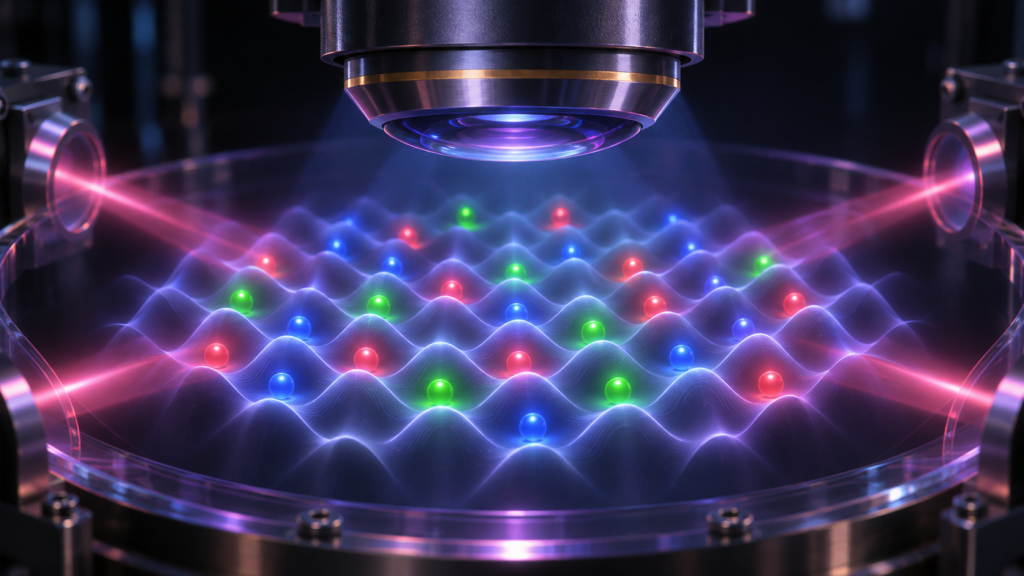
The researchers placed lithium-6 atoms in an optical lattice made with laser light. Atoms can move between neighboring lattice sites through quantum tunneling. While the conventional Hubbard model typically has two components, this experiment uses three distinguishable internal atomic states. A magnetic field allows the researchers to tune the interactions between different pairs of states.
A quantum gas microscope can locate individual atoms and identify their components. This makes it possible to measure local configurations and correlations, rather than just averaged properties of the cloud.
What the researchers found
A key result was the observation of a Mott insulating state. Strong interactions suppress double occupation of lattice sites and hinder the motion of atoms, producing insulating behavior that a simple model of independent particles would miss.
The same system displayed competing magnetic correlations: some pairs of components showed ferromagnetic correlations, while others displayed antiferromagnetic ones. The scientists also measured sites occupied by all three components and compared the measurements with numerical calculations by collaborators at Rice University. The research reports signatures of component-selective localization and pairing as well.
Why this matters
Even the two-component Hubbard model is difficult to solve in many regimes. A third component expands the range of collective states that can be studied and gives theorists new ways to test their methods. The researchers hope eventually to explore selected features of lattice quantum chromodynamics. This does not mean they have created actual quarks or a universal quantum computer.
Relevance to Genesis
The central lesson for Genesis is methodological: establish a small set of local interactions, change their parameters, and see which collective structures emerge without being explicitly designed. This is close to our goal of allowing stable objects to arise from the dynamics of a virtual substrate.
Our numerical model is not equivalent to a quantum gas. The parallel is conceptual and methodological, not evidence that Genesis already reproduces quantum physics.
Sources
Original research in Science (DOI) · University of Hamburg — research summary · SecurityLab — source news article (Russian).

