10.03.2025 Something grandiose!!!
It seems to me that I have discovered something grand. One fundamental rule plus one tactical approach have combined to produce a very interesting effect, which has already shown initial results when attempting to run the program code for a virtual simulation. This is a very elegant solution that may provide answers to questions such as how to connect quantum mechanics and general relativity.
But that’s not all! With a certain degree of confidence, one can expect to unravel the mystery of how life emerged from non-life. I am overwhelmed with emotions because I want to share these first results with everyone, but I understand that this would be a hasty decision. In such cases, we have a saying: «I was looking for copper, but found gold.»
Right now, I am a bit confused because I had planned to make a bold statement about my project in the information space, but first, my discovery needs to be reverified. Secondly, I obviously need to learn programming myself and avoid involving external developers to prevent any information leaks before releasing the MVP.
13.02.2025 Voting Concept
I came up with the idea to add a section to the project website where development strategies are published in several variants, with a voting block placed next to each one. Voting access will be granted only to authenticated users among the donors. Each voter will be assigned a vote weight coefficient based on the amount they donated.
- Concept
1.1 To ensure voting transparency, I plan to:
Publish the voting results in real time or after the vote has ended, so donors can see how the votes are distributed.
Provide each participant with the ability to see their contribution and its weight in the overall result.
1.2 To ensure fairness, I plan to:
Apply a logarithmic distribution of the vote weight. For example, if a donor donates twice as much, their vote may not weigh twice as much, but only slightly more, to avoid excessive influence from large donors.
Limit the maximum vote weight to prevent the dominance of a single participant.
1.3 For considering activity:
Add a bonus system for participating in discussions, suggesting ideas, or helping the project. This could allow active participants to receive additional vote weight regardless of the donation amount.
1.4 Classification and reduction of voting items:
Divide the voting into several categories:
- strategic (long-term plans),
- tactical (short-term steps),
- financial (fund allocation).
This will help avoid excessive bureaucracy for minor issues.
1.5 Voting format.
For complex issues, an option for comments can be added where users can justify their choice. This will create dialogue among participants and increase engagement.
You could implement multi-round voting to select the best ideas.
- Examples
2.1 Logarithmic vote weight.
The idea is that the contribution to the vote increases with the donation amount, but not linearly, rather it slows down.
Formula:
W = log(S)
Where:
W — vote weight;
S — donation amount;
log — logarithm, for example, base 10.
Example with logarithm:
Participant 1: S = 10,000 → W = log10(10,000) = 4.
Participant 2: S = 1,000 → W = log10(1,000) = 3.
Participant 3: S = 100 → W = log10(100) = 2.
Result: There is a difference between the votes, but it is significantly smaller than with a linear distribution.
For example, the first participant donated 10 times more than the second, but their vote only weighs 1 unit more.
2.2 Upper limit of weight
Setting an upper limit for the vote weight (W max) means that even if a donor contributes an astronomical amount, their vote will not increase indefinitely.
Example with an upper limit:
Suppose W max = 5. Then:
Participant 1: S = 10,000 → W = min(log10(10,000), 5) = 4.
Participant 2: S = 1,000 → W = min(log10(1,000), 5) = 3.
Participant 3: S = 100 → W = min(log10(100), 5) = 2.
If a participant appears with S = 1,000,000:
W = min(log10(1,000,000), 5) = 5
Result: Limiting the vote weight prevents imbalances in the voting due to excessively large donors.
Question: if a fifth participant appears and donates ten times more, will they also get a weight of 5?
Is a dynamic weight adjustment system needed?
If so, a formula for dynamically calculating the weight could be considered, but this might complicate the system and make it less predictable for the participants:
| Log10(Si) | ||
| Wi = | ———————— | x Wmax |
| Log10(Smax) |
Where:
S i — the donation amount of the participant;
S max — the largest donation amount;
W max — the maximum vote weight.
- Protection against manipulation.
For example, instead of donating 1000 to receive a vote weight of 3, a participant might create ten accounts and donate 100 from each, obtaining 10 votes with a weight of 2 each, totaling 20.
To prevent such actions, a number of measures are required:
3.1 Link the account to the identity
Identity verification requirement: Link accounts to real data, for example, via email, phone, or even KYC (Know Your Customer). This will make it harder to create multiple fake accounts.
Donation identifier: When donating, record a unique ID tied to the person rather than the account. This way, voting will be allowed only from one account for the total sum of their donations.
3.2 Summing donations
All donations made by a single person, even from different accounts, will be aggregated:
For example, if a person donates 10 times 100, the final weight will be calculated based on the total sum
S = 1000, rather than on fractional payments.
How to implement:
Link payments to a unique identifier (for example, card number or email).
If the identifier matches, the system will automatically combine the donations.
3.3 Monitoring and analytics
Create a system to detect suspicious activity, for example:
Registration of multiple accounts from the same device/IP.
Frequent small donations from the same user.
If anomalies are detected, allow the possibility to dispute the votes.
3.4 KYC
To prevent a situation where one participant obtains three identifiers by paying with three different payment methods (Paypal, crypto, money transfer), a KYC (Know Your Customer) identity verification system is required.
To avoid leakage of personal data and reduce the project team’s liability for handling and storing personal data, external resources can be used:
Sumsub (sumsub.com):
Suitable for crypto projects, with flexible configuration.
Onfido (onfido.com):
Works excellently with documents and biometrics.
Jumio (jumio.com):
Provides solutions for banks and cryptocurrency exchanges.
IDnow (idnow.io):
Strong presence in Europe, supports various types of documents.
Civic (civic.com):
Specializes in crypto projects, using blockchain for data protection.
Thus, both security and compliance with legislation will be achieved, as companies offering KYC services usually already comply with GDPR, CCPA, and other regulations.
In addition, donors will feel more protected if their personal data is transmitted to a certified service rather than a private project.
06.02.2025 New Logo
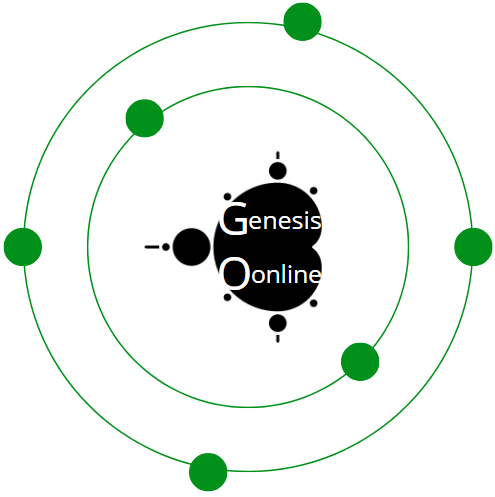
It has been a long time since the last update. In my personal life, everything has changed dramatically, I separated from my wife, and for a while I tried to put myself back together to find the strength for the project. Today I came up with a new logo for the website. What do you think?

24.12.2024 Logo
The website is almost ready; the launch will be soon. Although I caught a cold today and, apparently, I won’t be able to finish it before the end of the year as previously planned.
Here is the approximate concept for the website logo. But there is something I don’t like about it…
To the top
 GÉNESIS-ONLINE.COM